Written by NexDoor Editorial Team | Reviewed by NexDoor Advisory Team | Apr 2026
A 67% price increase sounds like the window has closed. It hasn't.
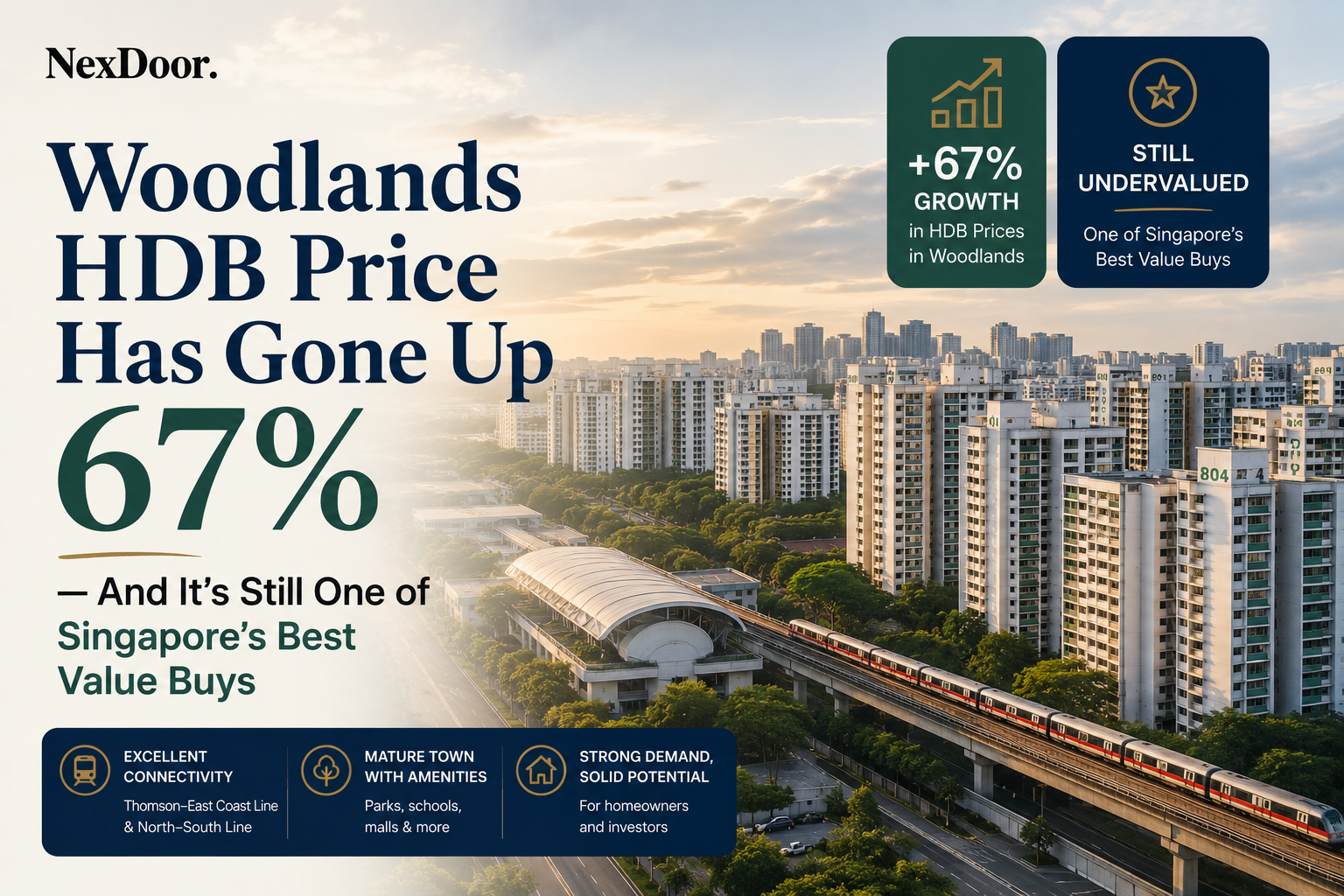
Woodlands 4-room HDB resale prices moved from a median of $330,000 in 2019 to $550,000 in 2026 — a significant run by any measure. But price and value are not the same thing, and in Woodlands' case, the reasons behind that price movement are exactly why buyers in 2026 are still looking at one of the most compelling HDB value propositions in Singapore.
Here is what the data shows, and why the story is more interesting than the headline number suggests.
The 7-Year Price Story
| Year | Median 4-Room Resale Price | YoY Growth |
|---|---|---|
| 2019 | $330,000 | — |
| 2020 | $350,000 | +6.1% |
| 2021 | $400,000 | +14.3% |
| 2022 | $450,000 | +12.5% |
| 2023 | $490,000 | +8.9% |
| 2024 | $540,000 | +10.2% |
| 2025 | $560,000 | +3.7% |
| 2026 | $550,000 | -1.8% |
From 2019 to 2026, Woodlands 4-room flats gained approximately 67%. That is a major repricing. But it did not happen randomly.
The Thomson-East Coast Line changed Woodlands' connectivity story. The Woodlands Regional Centre gained momentum. The north region stopped being perceived as remote and started being understood as a genuine employment, lifestyle, and transport node.
Why Woodlands Still Offers Value
Even after the 67% increase, Woodlands remains meaningfully cheaper than many mature estates with weaker transformation narratives.
A 4-room flat at around $550,000 in 2026 still gives buyers access to MRT connectivity, regional centre growth, larger unit sizes, and a mature neighbourhood with established amenities. In many other estates, comparable fundamentals already price well above $650,000 to $750,000.
The gap is not because Woodlands lacks fundamentals. It is because the market still prices in a north-region discount — even though the infrastructure gap has narrowed significantly.
The TEL Effect
The Thomson-East Coast Line is the single most important factor in Woodlands' repricing. It transformed what used to be a long and inconvenient commute into direct connectivity to Orchard, Great World, Marina Bay, and the eastern corridor.
Transport upgrades do not merely make daily life more convenient. They expand the buyer pool. A location that once appealed mainly to north-region families now becomes realistic for buyers working across central Singapore. That broader buyer pool supports resale liquidity and long-term demand.
What the 2026 Data Tells Us About Timing
The stabilisation of Woodlands prices in 2026 — median $550,000 against $560,000 in 2025 — suggests this is not a market in freefall or continued acceleration. It is a market digesting a large infrastructure-led repricing.
For buyers waiting for a significant correction, the data does not support that expectation. The drivers of Woodlands' repricing — TEL connectivity, regional centre development, and limited affordability alternatives — remain intact. But the slower growth rate does suggest buyers have more room to assess options carefully than they did during the sharpest growth years.
Who Woodlands Works For in 2026
Woodlands at current prices makes the most sense for buyers who:
Are first-timers eligible for the resale grant stack, which significantly reduces net acquisition cost
Want genuine MRT connectivity — TEL access to Orchard in 20 minutes — without paying private property prices for it
Value space and a mature estate over postcode prestige
Have a medium to long holding horizon and are buying a home rather than timing a trade
It is a less straightforward proposition for buyers who need to minimise cash outlay with limited grant eligibility, or who are purchasing primarily on the expectation of short-term capital gains.
The north region story is not over. If you want a clear breakdown of what Woodlands actually costs after grants, financing, and realistic holding assumptions — and how it compares to your other options — NexDoor is happy to work through the numbers with you.
📩 Reach out to NexDoor — let's look at what the numbers mean for your specific situation.
Source: HDB Resale Flat Prices, data.gov.sg