Written by NexDoor Editorial Team | Reviewed by NexDoor Advisory Team | Mar 2026
There is a particular kind of property that makes Singapore buyers nervous. It is older than 40 years. It carries a leasehold clock that everyone can see ticking. And it is consistently described, in property circles and family group chats alike, as the purchase you make when you don't know any better.
The data disagrees.
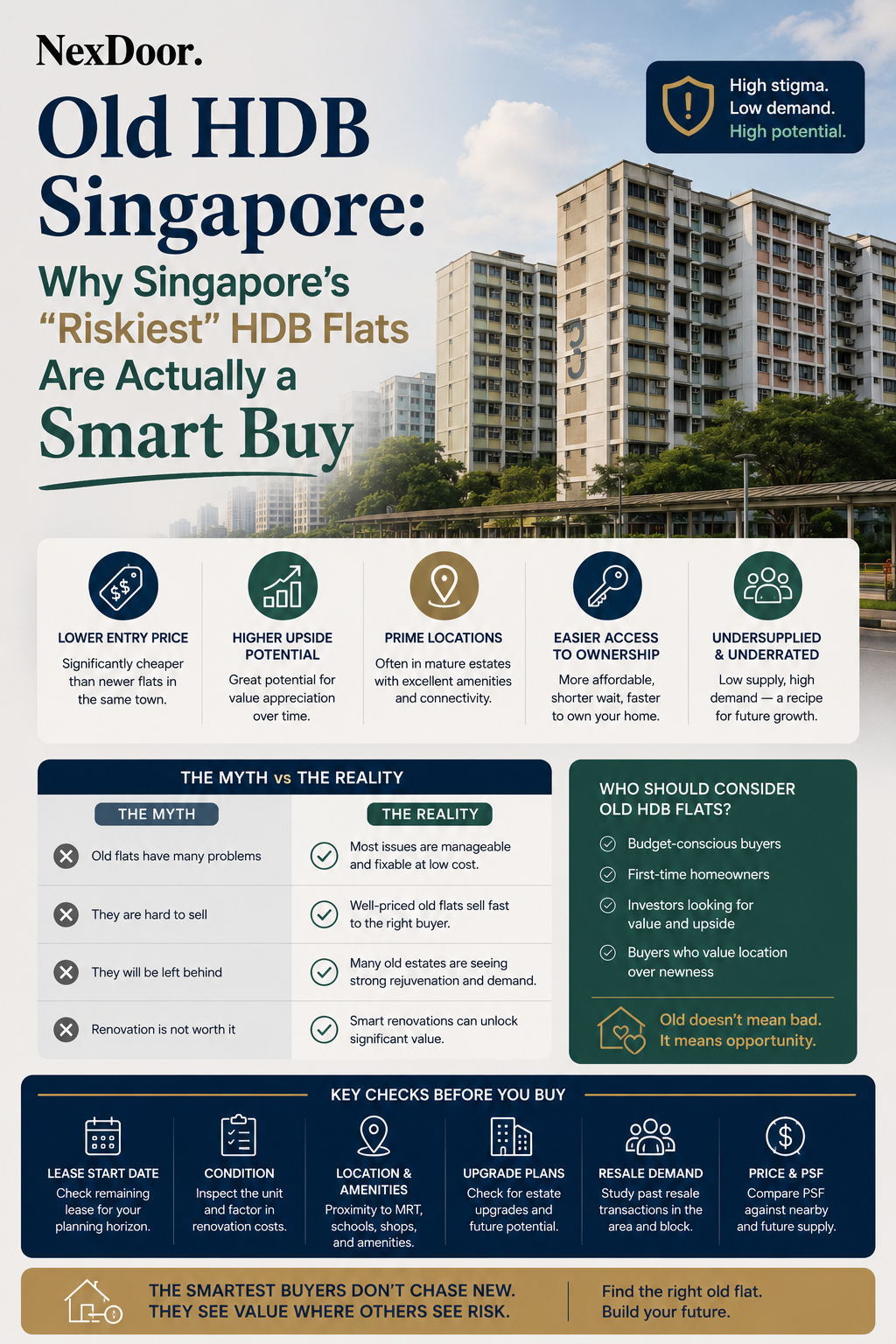
For the right buyer, an older HDB flat is not the risky choice. It is frequently the most rational one — offering more space, better value, and a faster path to homeownership than the alternatives most buyers are chasing.
What You Actually Get
Let's start with the physical reality, because it matters more than most buyers initially consider.
HDB flats built in the 1980s commonly range from 1,200 to 1,400 sqft for a 4-room unit. Today's BTO 4-room flats average around 1,000 sqft. That is not a minor difference. That is another bedroom's worth of breathing space, a dining area that does not fight the living room, or simply the difference between tolerating a home and enjoying it.
That additional space comes with established infrastructure around it. Mature estates have hawker centres, schools, parks, clinics, MRT lines, bus routes and neighbourhood rhythms that have been built over decades. You are not waiting for the estate to become liveable. It already is.
The Price Gap and What It Means For You
Older HDB flats trade at a meaningful discount to newer resale units in comparable locations. The gap varies, but a difference of $150,000 to $250,000 is not unusual between an older, spacious flat and a newer, smaller one in the same broad estate.
That discount is the key to making the numbers work. A thorough renovation of an older flat — electrical, plumbing, flooring, carpentry and bathrooms — might cost $80,000 to $120,000. Even after renovation, many buyers still enter at a lower total cost than they would have paid for a newer resale flat of smaller size.
This is the calculation that rarely gets made in conversations dominated by fear rather than analysis. The renovation cost is visible and emotionally painful. The premium paid for newer lease balance is less visible — but often much larger.
The Lease Question, Answered Honestly
Lease decay is real. We are not going to tell you otherwise. But whether it matters to you specifically depends almost entirely on your holding timeline — and far less on general market fear.
Consider a buyer in their late thirties purchasing a flat with 57 years of remaining lease. By the time the lease runs out, that buyer will be in their nineties. If the buyer's actual plan is to hold the flat for 10 to 20 years, live comfortably, and possibly right-size later, the lease is not automatically a deal-breaker.
The question worth asking is not "how old is this flat?" It is "does this flat serve my actual timeline well?" For a large number of buyers, the answer is yes.
Where It Gets Complicated
There are buyer profiles for whom an older HDB flat genuinely does not make sense, and it is worth being clear about this.
CPF usage on flats with remaining leases below 60 years is subject to prorated restrictions based on whether the lease covers the youngest buyer to age 95. For very old flats, this can affect CPF usage and loan quantum. Financing has to be checked carefully before making any offer.
If you are in your twenties, buying with maximum financing dependence, or prioritising resale demand and broad buyer appeal at exit, a newer flat is likely the cleaner option. There is nothing wrong with that. The point is not that old HDB flats are always better. The point is that they are often dismissed too quickly.
But if you need space now, value a mature estate, have accumulated savings that reduce financing pressure, and are buying a home rather than timing the market — an older HDB flat can be a very rational choice.
The Buyers Who Get This Right
The buyers NexDoor sees making the most of older HDB flats share a few characteristics: they know their timeline, they have done the price gap calculation honestly, and they are not pretending the flat is something it is not. They buy it for space, location, and usability — not because they expect it to behave like a brand-new asset.
They move in faster. They live in more space. And they do it at a net cost that, once renovation is accounted for, often compares favourably to what their peers pay for newer but smaller homes.
The "risky" label has persisted because it sounds prudent to avoid old things. The numbers, looked at clearly, tell a more interesting story.
If you are weighing an older HDB flat against newer alternatives and want an honest breakdown of whether the numbers work for your specific situation, NexDoor is happy to walk through it with you.
📩 Reach out to NexDoor — let's look at your numbers together.
Source: HDB.gov.sg (2025/2026 figures)